
Searching Rice County Criminal Dockets
For most public Rice County criminal cases, the statewide remote tool is Minnesota Court Records Online. It goes by MCRO. In Case Search, pick Person for a name search. Or type a full case number. Set Court Locations to Rice and Case Category to criminal to narrow results. A statewide search still helps when you are not sure where the filing happened. Before relying on any result, check the court location, filing date, party role, and case number. Match each one against what you already know about the case.
A complete case number beats everything else. Public materials show a synthetic Rice pattern like 66-CR-26-0000. Here 66 is the county code. The CR simply marks a criminal case that requires a court appearance. MCRO guidance allows dropped dashes and leading zeros, but no spaces. Do not enter a citation number as a criminal case number. It is a different identifier. Read the Rice County code together with the Rice County court-location filter. That pairing gives a clean docket search.
- Open MCRO Case Search and choose a person search or enter the complete case number.
- Filter the results to Rice and the criminal category when more than one case appears.
- Open View Case Details and verify the title, court location, filing date, judicial officer, and party role.
- Read charges, case events, hearings, disposition, and sentencing as separate parts of the record.
- Use Rice County Court Administration for a courthouse record, a copy question, or a case that is not remotely available.
Note: A name match alone proves little, because MCRO returns similarly named people across the whole state.
Rice Criminal Case Codes
Rice County criminal case numbers start with the 66 county code. Then come a case-type code, a two-digit year, and a sequence. CR is not a finding of guilt. It just marks a criminal case that requires an appearance. VB sits at the other end. It is a payable, nonmandatory appearance matter that normally travels the citation route. Knowing the difference steers you to the right record. The label never tells you the outcome, only the path.
- Charge
- An alleged offense listed in the Rice County criminal case. A charge is not a conviction.
- Plea
- A response to a Rice County charge that is separate from sentencing and from overall case status.
- Disposition
- The recorded result for a Rice County charge or case, such as dismissal, conviction, or another final action.
- Case status
- An administrative Rice County label such as Open or Closed, not a shortcut for the result of each charge.
For a plain-language explanation of case and citation numbering, see the Minnesota citation and case-number guide. Codes tell you how to search; Case Details holds the real filing and event history. Rice County codes mark a Rice County filing, never its result.
Inside a Rice County Criminal Docket
The Rice County criminal Register of Actions is the case record in time order. MCRO shows it as Case Details. Read the case header first: court location, judicial officer, status, and party roles. Move on to the charge section and any amendments. Case Events can list notices, motions, orders, and document indexes. Hearings and bond or bail entries may also appear. So may interim conditions, financial entries, judgment information, related cases, and security indicators. Skim the whole sequence, not just the top of the page.
| Case number | Rice County code and type, such as synthetic 66-CR-26-0000, used to verify the case identity. |
|---|---|
| Charges | Rice County allegations and any recorded amendments. Read the disposition before calling a charge an outcome. |
| Case events | Rice County chronological entries for filings, notices, motions, orders, and other court actions. |
| Hearings | Rice County scheduled and past settings, including the event type, date, and court information. |
| Disposition and sentence | Rice County case-detail areas that identify the recorded result and any sentencing entry. |
| Security indicators | Rice County flags that can signal reduced access to a document or field. |
The MCRO case-details handout walks through each section. It covers the whole system. A docket event may link to a public document. Even so, the event line is not automatically the full filing. Rice County case review depends on the event sequence, not one search row.
Rice Criminal Details in MCRO
MCRO offers three layers: case search, document search, and hearing search. Case Search is the broad route into the Rice County criminal Register of Actions. Document Search needs a complete case number. It returns a document index where public documents exist. Hearing Search works from a name, case number, judicial officer, or attorney. Pair it with a date and court-location filter. Each layer answers a different question about a Rice County court docket. So a missing document is not proof that the case or event never existed.
Public criminal documents filed on or after July 1, 2015 may be available remotely under the MCRO access handout. Category, filing date, and security designation still control. When an expected PDF is absent, the accessible-case-types matrix is the better reference. Rice County Court Administration can explain the access path for a Rice County case. It cannot make a restricted record public.
The Rice County Attorney's Office describes its role. It is the office that prosecutes public criminal filings.
Prosecution and record custody are separate jobs. The office that handles a Rice County criminal docket for public access is Court Administration, which remains the contact for court records questions.
How a Criminal Case Moves
A Rice County criminal docket develops through entries rather than one single line. A typical Rice County sequence is Filing → Arraignment → Pretrial → Plea or Trial → Disposition → Sentencing. Rice County calendar labels can be more specific, including First Appearance, Initial Appearance, Omnibus Hearing, Settlement Conference, Motion Hearing, Violation Hearing, and Court Trial. The label marks a scheduled event. It does not announce what the court decided.
Read docket entries in order. A complaint, a motion, an order, and a disposition all mean different things. A plea can show up well before a separate sentencing event. Likewise, a Closed status tells you little. It does not say whether each charge was dismissed, resolved, or restricted. The Rice County case-detail record will always say more than a short search-results row.
For a next-day check on a setting, Rice County's daily calendar can help. Treat it as an operational roster. It is not a full criminal docket. It is not a cancellation notice.
Rice Criminal Hearing Checks
Need a hearing date, a judicial officer, an attorney, or one specific case in Rice County? Start with the MCRO Hearing Search. The Rice daily calendar shows hearing location, date and time, judicial officer, hearing type, connection type, and case number. Rice posts next-day activity at 7:00 p.m. It refreshes the calendar hourly starting at 7:00 a.m. Three courthouse monitors carry the same schedule locally. If the displays and the court notice disagree, the court notice wins.
A Zoom Session entry is not self-explanatory. You will need the hearing notice or Court Administration for connection instructions. Rice Policy 525 sorts appearance methods by criminal event category. A later order can change the method for a single case. Keep one caution in mind. If a setting is missing from the Rice County calendar, that does not mean the hearing was cancelled or reset.
Note: Recheck a Rice criminal setting close to hearing time. The public calendar can change after its evening posting.
Courts That Hold Criminal Dockets
Criminal charges in Rice County land in the Rice County District Court. It sits in Minnesota's Third Judicial District. That court holds original jurisdiction over criminal, traffic, civil, family, probate, juvenile, and other county filings. There is no separate county criminal-court tier here, and no city municipal criminal docket on this search path. Even a case that starts with a local officer or a city ordinance can reach the county District Court once it is filed as a court matter.
Appeals flow from the Rice County District Court to the Minnesota Court of Appeals, not to any county appellate docket. The courthouse location and calendar appear on the Rice County District Court page. The official site maintains that page with current details.
Charging resources from the prosecution side make useful background. But filings, settings, and copies stay within the District Court record system.
Rice Criminal Docket Custodians
For docket and access questions, the local office is Rice County Court Administration. It sits in the Rice County Courthouse at 218 N.W. Third Street, Suite 300, Faribault, MN 55021. Call (507) 497-7134. Listed hours run Monday through Friday, 8:00 a.m. to 4:30 p.m. The title matters in Minnesota. The court record custodian here is Court Administration rather than a separately elected county clerk.
Rice County Court Administration
Rice County Courthouse
218 N.W. Third Street, Suite 300
Faribault, MN 55021
(507) 497-7134
Monday through Friday, 8:00 a.m. to 4:30 p.m.
Court Administration handles courthouse inspection of Rice County records, written requests, certification, and any record cut off from remote access. Parties filing documents can use Minnesota eFile and eServe, known as eFS. Keep its role straight: eFS files and serves papers, but it is not a public search portal.
Sealed Dockets and Public Access
Public access in Rice County rests on Minnesota Judicial Branch rules. There is no blanket promise that criminal material is online. Rule 4 sets the overall access framework. Rule 8 then splits Rice County courthouse inspection from the narrower remote access. It restricts certain identifiers, protected case types, and documents. Rule 7 permits an oral or written request so long as it identifies the record well enough. When a public search fails to return an expected record, Rice County Court Administration can explain the correct route.
Rice criminal access limits: Rule 4 frames public court-record access; Rule 7 sets the request process; Rule 8 limits some remote access; and Rule 11 addresses restricted identifiers and redaction.
Expungement under Minn. Stat. § 609A.03 can seal a record by statute or by order. Sealing is not destruction. Rice County juvenile records follow separate boundaries set by Minn. Stat. § 260B.171, and Rice County electronic access can run narrower than courthouse access.
Rice Criminal Access Limits
A Rice County criminal search can come up empty for simple reasons. The spelling may be off. The date range, county filter, or case type may not fit. A record can also be missing remotely. It may be sealed, juvenile, protected, older, or otherwise outside public online coverage. Use a verified case number first. Then try a careful spelling variant. Widen from Rice County to statewide only if you must. Ask Rice County Court Administration about the access route.
Do not copy restricted identifiers from a docket image or rebuild them from other material. Rule 11 puts redaction duties on filers and offers a court process for confidential information. Remember that a public charge, a visible hearing, or a closed case does not make every attachment public. For a fuller name-or-number search before ordering a copy, take the Rice County case lookup path.
The Minnesota expungement statute is the official word on the sealing procedure.
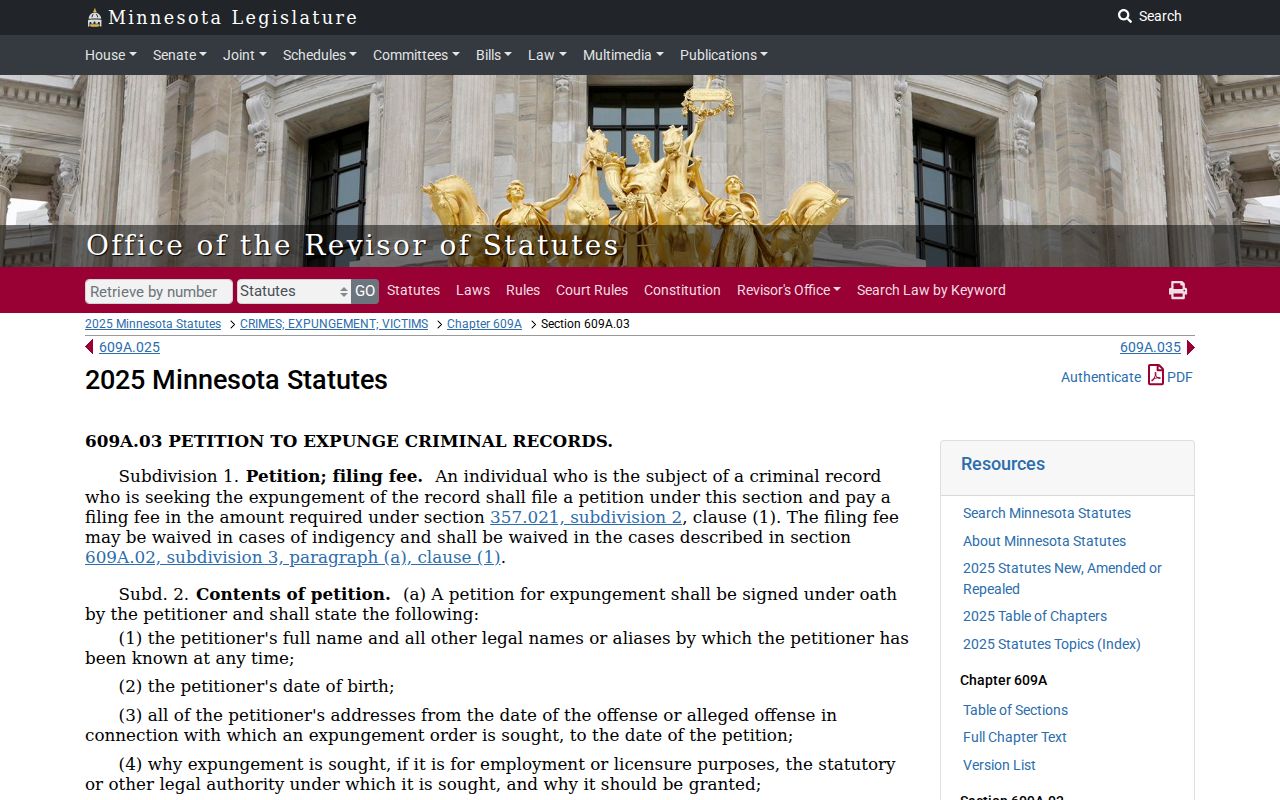
That statute points to a careful rule for Rice criminal dockets. Follow the court's current access decision rather than inferring availability from a search result.