
Getting Rice County Court Records
Every request begins with the right case. Rice County Court Administration holds the District Court records for cases filed in the county. That office is the destination once you know what you want. For remote access, Minnesota Court Records Online (MCRO) is the usual first stop. It covers public case details and documents.
Have the full case number ready if you can. Without it, a party or business name, a filing period, and a case category will still narrow things down. The Register of Actions lists every case event in order. That history is the best way to name the exact document, judgment, or order you need.
- Search MCRO for the case number, party or business, citation number, or attorney. Narrow the court location to Rice when the case belongs in Rice County.
- Confirm the case number, filing date, case category, and document or event description before asking for a copy. A Rice example format is 66-CV-26-0000; it is a synthetic example, not a case record.
- Choose the access channel. MCRO is remote; Rice Court Administration can answer local access questions by phone, at the courthouse counter, or through the statewide copy-request process.
- State whether a plain, certified, or exemplified copy is needed. Identify the exact document, event date, and delivery preference.
- Confirm the current fee and any access limit before payment. Older, restricted, and off-site material can require a different route.
Note: A daily calendar only lists scheduled hearings. A record request should point to a Register of Actions entry or one specific document.
Rice Court Record Search: MCRO and the Counter
Two routes cover most Rice County record searches. MCRO works remotely and statewide, at no charge. Rice County Court Administration handles the counter route when remote access falls short. MCRO is not, however, a certified-copy desk, a payment system, or an e-filing service.
Its four tools are Case Search, Document Search, Hearing Search, and Judgment Search. Document Search needs a complete case number. Case Search is looser, accepting a name or a citation number. A file will not always surface remotely. Court Administration can then point you to the courthouse terminal, a copy request, or the procedure for restricted material.
Minnesota's copy-request instructions draw the line between an online view and the court's copy process. The official source lays out plain, certified, and exemplified requests. It also covers in-person, mail, and case-related e-filing routes. Do not send a general request as an anonymous e-file submission. Ask the local office how a specific record should be delivered.
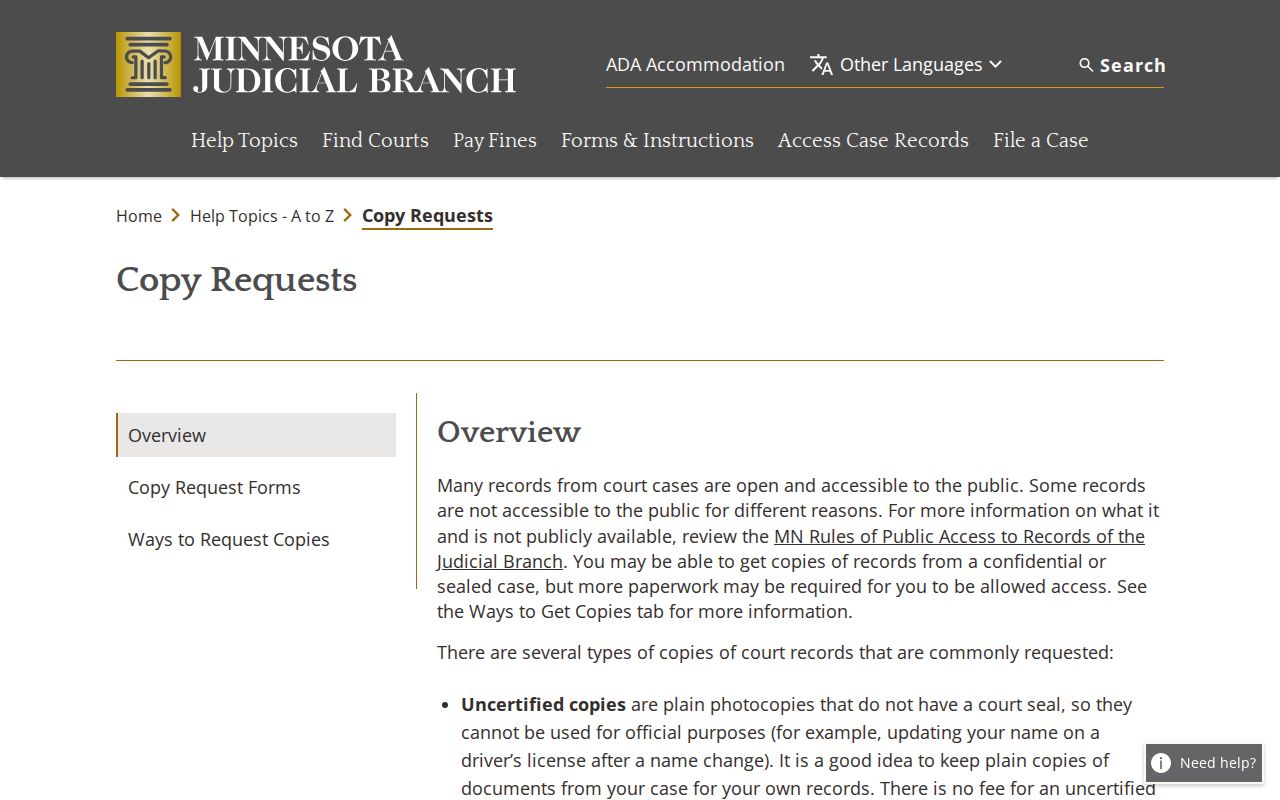
Think of the copy request as the bridge between an online case result and a court-issued record. Naming the item up front also prevents a request for the wrong thing.
Court Record Types
One Rice County court record can mean several things. It might be a filing, a hearing entry, or a judgment record. Name the product, not the whole file. What is public depends on the case category. The filing date and any access rule or order matter too. MCRO may show a case event while the filing behind it stays unavailable remotely.
- Register of Actions: the case-level event history, also called Case Details in MCRO.
- Filed documents: public pleadings, motions, affidavits, orders, and document-index entries where access allows.
- Judgment material: monetary judgment details, satisfactions, interest, and related history.
- Hearing information: scheduled and past setting data from MCRO or the Rice daily calendar.
- Official copies: plain, certified, or exemplified copies supplied through the court's process.
Rice County District Court handles civil, criminal, traffic, family, probate, juvenile, and conciliation cases. The remote-access rules, though, differ from one kind of file to the next.
Name the Rice County Court Record Precisely
A precise request saves time. For a Rice County file, give the case information. Include an exact event date so the court can locate the record. Know the vocabulary, too. A document is the actual filing or court-generated item. The Register of Actions is the event history. A judgment records an outcome or money owed. A satisfaction can show later payment or resolution. The Rice daily calendar is only a schedule, never the underlying file. MCRO Case Details supplies the document name, index number, and event date. Those details make a request clear.
The MCRO case and judgment details handout walks through each section of a result. Use those fields to tell a charge from a disposition. They also separate a hearing from an outcome and a case status from an access decision. If a record is old or missing online, bring the identifier and approximate date to Court Administration. An empty remote result is not proof that no file exists.
Note: A closed status does not reveal much. It may not show whether every filing in a Rice County court record is viewable remotely.
Inside a Rice County Court Record
Case Details and the court file are different layers of the same Rice County matter. The online view confirms you have the right case. It may link to eligible public documents. A court copy request then pins down the exact official item. Available fields vary by category and access level.
| Case number | The MNCIS identifier. Rice numbers use county code 66 and a case-type, year, and sequence pattern. |
|---|---|
| Case information | Title, category, filed date, court location, judicial officer, status, citation number, related cases, and flags where public. |
| Case events | Chronological entries with event descriptions, document indexes, and view links when a public document is available. |
| Hearings and outcomes | Scheduled or past hearings, dispositions, orders, judgments, bond or bail, and financial sections when applicable. |
| Security limits | Redaction, restricted identifiers, sealed status, or a case-specific rule can limit remote or courthouse access. |
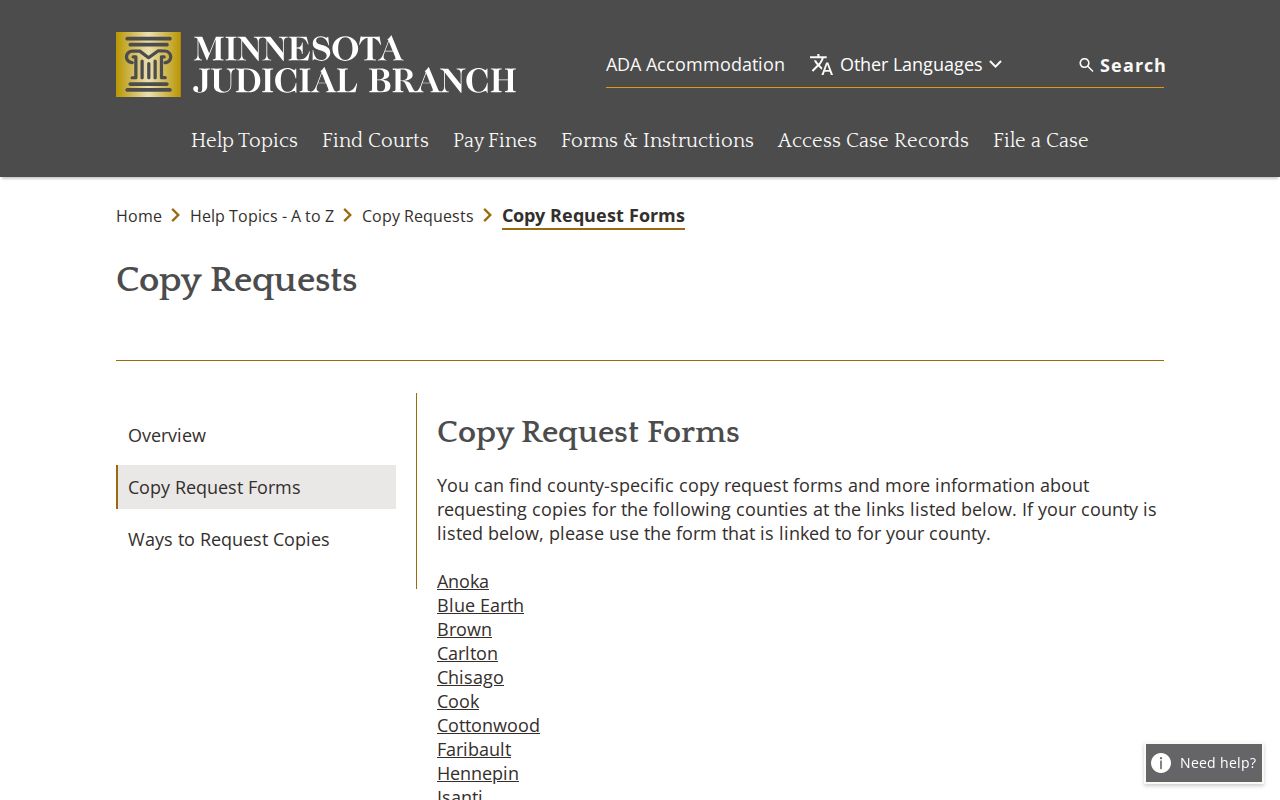
The statewide form index is handy for checking available routes. Rice County posts no current Rice-specific copy form. Confirm the local request method before relying on a form from another county.
When a Rice Court Record Has No Online Document
A missing online document does not mean the Rice County court record is closed. Rice County Court Administration can walk you through whatever courthouse route still works.
Start with MCRO's limits. Public major and minor criminal and civil documents filed on or after July 1, 2015 may be available remotely. Coverage varies. Family cases often have narrower document access, especially party-submitted financial material. Juvenile, domestic-abuse, harassment, child-protection, and other protected records follow special rules. So a document that fails to appear might reflect a rule, a date limit, sealed status, a wrong search field, or a file you simply must inspect where it is kept.
Outside MCRO coverage, you still have options. Call Rice Court Administration at (507) 497-7134. Stop at the courthouse counter during court hours, or follow the statewide copy-request instructions. The courthouse sits at 218 N.W. Third Street, Suite 300, Faribault, Minnesota 55021. A Rule 7 request can be oral or written. Identify the record well enough for staff to find it. You generally do not need to explain why you want access. Just asking for it is enough.
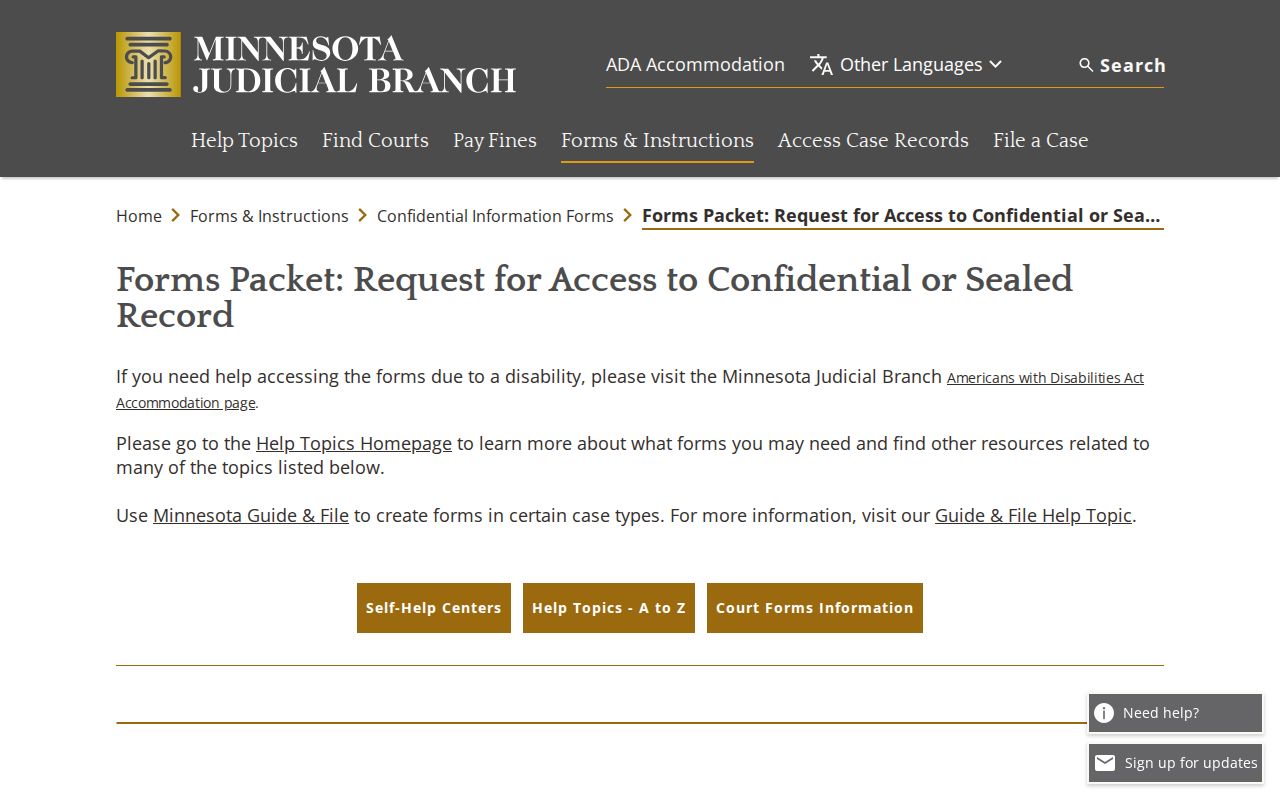
CON100 and CON101 are the official packet for requesting access to confidential or sealed material when you may qualify. Filing them does not make a restricted record public.
Choose the Right Rice Court Record Copy
Tell Rice County Court Administration exactly which Rice County document you need. Name the copy format too. That one detail saves time.
Staff can sort out the format before you submit a request. A plain copy works for reviewing a public filing or event. A certified copy carries the court's certification. An exemplified copy adds a layer of judicial authentication. The receiving office usually dictates the choice. So name both the document and the format rather than asking for a generic certified case file.
The statewide copy instructions cover in-person and mail methods. E-filing, in turn, serves authorized users making case-related filings. Ask whether the file is on site. Also ask whether certification, scanning, or another service changes the charge. That keeps a Rice court record request aimed at the real document. It also avoids mistaking an MCRO screen image for an official copy.
Fees and Certified Copies
The Rice County fee schedule covers court-copy services, not every other Rice County government record.
Know the formats. A plain copy has no certification. A certified copy bears the court's certification. That is often what an official purpose demands. An exemplified copy, meanwhile, adds judicial authentication. MCRO documents are free to view when remotely available. But MCRO cannot issue certified copies or court judgments. Confirm the item and the current fee with Court Administration. Formats and processing can change.
| Rice fee-page item | Displayed fee |
|---|---|
| Plain uncertified copy, printout, scan, picture, or screen print | $0 |
| Certified copy or certified imaged/e-filed printout | $14 |
| Exemplified plus uncertified copy | $14 |
| Certified plus exemplified copy | $28 |
| Case-management report, 1 to 50 pages | $5 |
| Scanning or faxing, 50 pages or part | $25 |
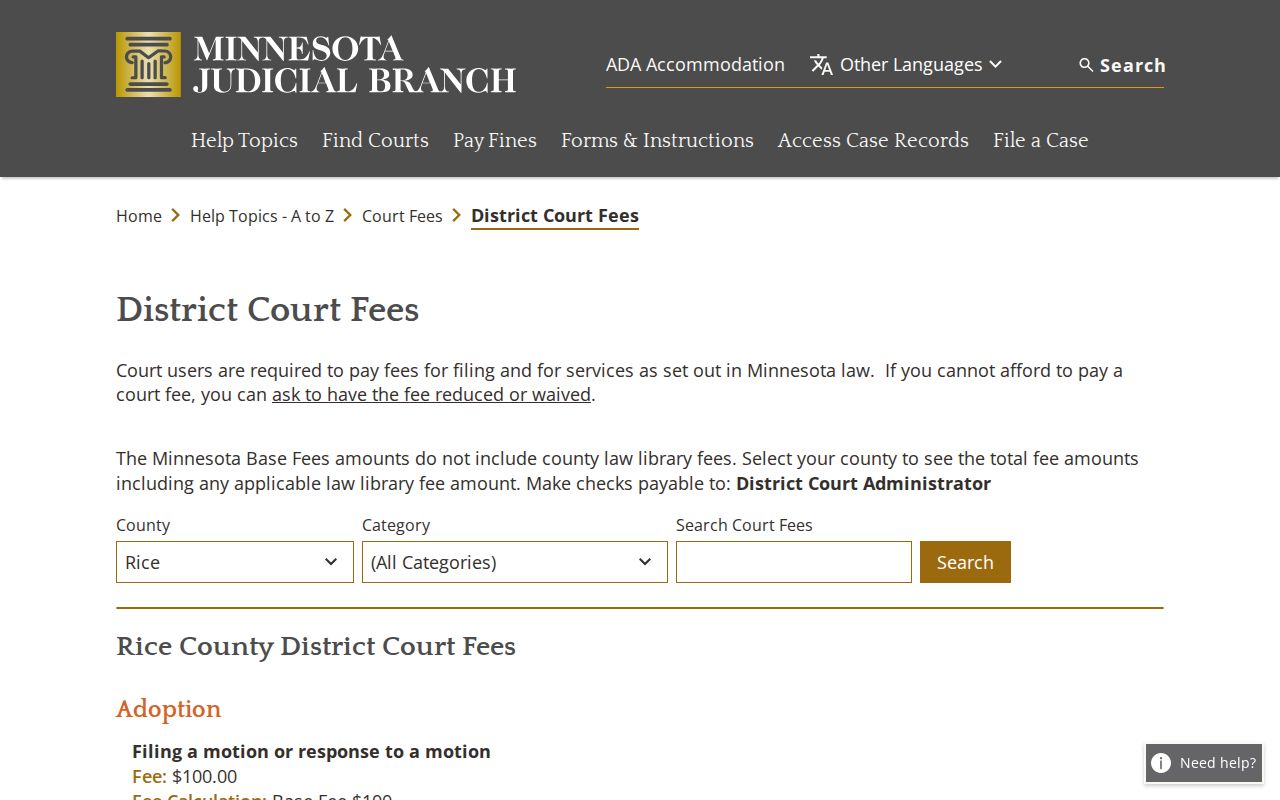
The official Rice fee page supplies the displayed rows. For any item outside that table, confirm the cost with the court instead of guessing from another record type.
Rice County Court Records at Court Administration
Rice County Court Administration handles district-court records for Rice County. Ask its counter about a court file. Ask about a hearing date, a filing, or access to a case record.
This office is not the County Attorney, the Sheriff, Community Corrections, or the Court Payment Center. Those offices each hold their own information. None of them replaces Court Administration for a copy of a Rice County court file. Driver histories sit with Minnesota DPS Driver and Vehicle Services, not the court.
Rice County Court Administration
Rice County Courthouse
218 N.W. Third Street, Suite 300
Faribault, MN 55021
(507) 497-7134
Monday-Friday, 8:00 a.m.-4:30 p.m.
Minnesota eFile and eServe is a filing and service system. It is not a public search tool. And it does not replace asking Court Administration how a copy request should be made.
Note: the archived Rice reduced-hours notice mentions fax, email, mail, and a drop box. Confirm with the court which of those channels it still accepts before relying on one.
Sealed Records and Public Access
Knowing a Rice County case by number does not unlock it. Minnesota rules govern every access question.
The main control is the Minnesota Rules of Public Access to Records of the Judicial Branch. That matters more than any blanket claim that court files are open. Public access can mean inspecting and copying a record where it is kept. Remote access excludes certain identifiers, categories, and documents. Sealed, confidential, juvenile, and protected matters each need a court-rule or case-specific analysis. And never try to rebuild a restricted identifier from a public image.
Key Minnesota access rules:
Rule 4 states the general public-access framework for judicial-branch records.
Rule 7 covers oral or written record requests and prompt response or explanation of a delay or denial.
Rule 8 distinguishes courthouse inspection from remote access and limits protected information.
Rule 11 requires redaction of restricted identifiers in filed material.
An expunged record can be off limits under Minn. Stat. § 609A.03 yet still exist. Juvenile access carries its own limits under Minn. Stat. § 260B.171. Ask Court Administration about the correct procedure. A blank MCRO result is not a conclusion.